New Chapter Zyflamend Review: Worth 76 Cents a Day? (2026)

Zyflamend is a well-made herbal blend at a price that is hard to defend: 76 cents a day for 780 mg spread across ten herbs, with turmeric — the reason most people buy it — accounting for 110 mg of that total. The 180-capsule bottle costs $67.97 at Amazon and at iHerb, the serving is two capsules, so one bottle is 90 days.
The comparison that settles this review is turmeric itself. NatureWise Organic Turmeric, which sits in our joint guide, delivers 500 mg of 95% curcuminoids plus 2,250 mg of turmeric blend for 36 cents a serving. Zyflamend delivers roughly a tenth of that curcumin and charges twice as much. You are not buying milligrams here; you are buying a fixed combination — rosemary, ginger, holy basil, green tea, Chinese skullcap, barberry, goldthread, oregano and hu zhang — from a Vermont B Corp that has sold the same idea since 1999.
The reviews are not the weak point. 4,577 Amazon ratings at 4.5 and 684 on iHerb at 4.8 make it one of the better-liked joint products on this site. The weak points are what the label’s “clinically studied” line actually points to, and how much herbal dose $68 buys.
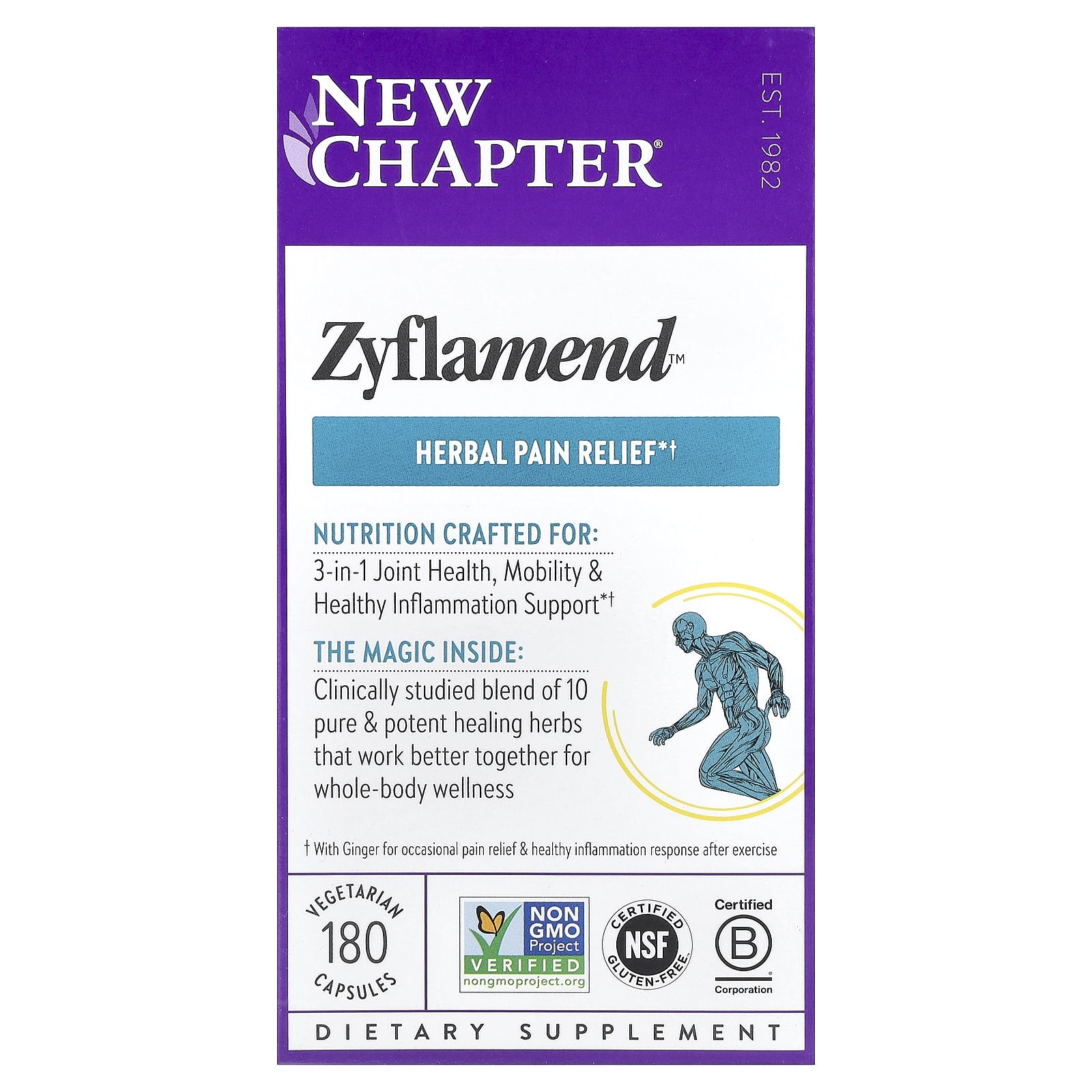
New Chapter Zyflamend Joint Support Supplement, 180 Vegetarian Capsules
4,577 Amazon ratings at 4.5; #7,965 in Health & Household.
110 mg of turmeric in a $68 bottle; curcumin per dollar is the trade-off.
Why people take Zyflamend
Joint discomfort is the reason most bottles leave the shelf, and the mainstream answer — ibuprofen, naproxen — works but comes with stomach and long-term cardiovascular caveats. That gap is where a product marketed for “healthy inflammation response” sells.
Zyflamend’s case rests on laboratory work. Its herbs inhibit COX-2 and NF-κB in cell and animal studies, which is a plausible mechanism and not the same thing as a demonstrated benefit in people with sore knees. New Chapter’s own product page footnotes the “clinically studied” claim to preclinical testing, and the human research that has been published on the blend focuses on inflammation markers and prostate cell lines rather than joint-pain endpoints. A 2010 review of anti-inflammatory supplements declined to recommend it for arthritis.
None of that makes the bottle worthless. It means the decision is a value decision: do the ten extracts, the clean label and the convenience beat a cheaper, single-ingredient curcumin? For some buyers yes. For most, the arithmetic is uncomfortable.
Quick verdict
- Best for — people who would rather take one multi-herb capsule than assemble four single herbs, and who already know their stomach tolerates strong extracts.
- Skip if — you want the most curcumin per dollar, you react to oregano or berberine, or you take medication cleared by CYP3A4.
- What stands out — ten extracts rather than ten powders, a genuinely clean certification list, and a review page where buyers name specific problems they stopped having.
What you actually get
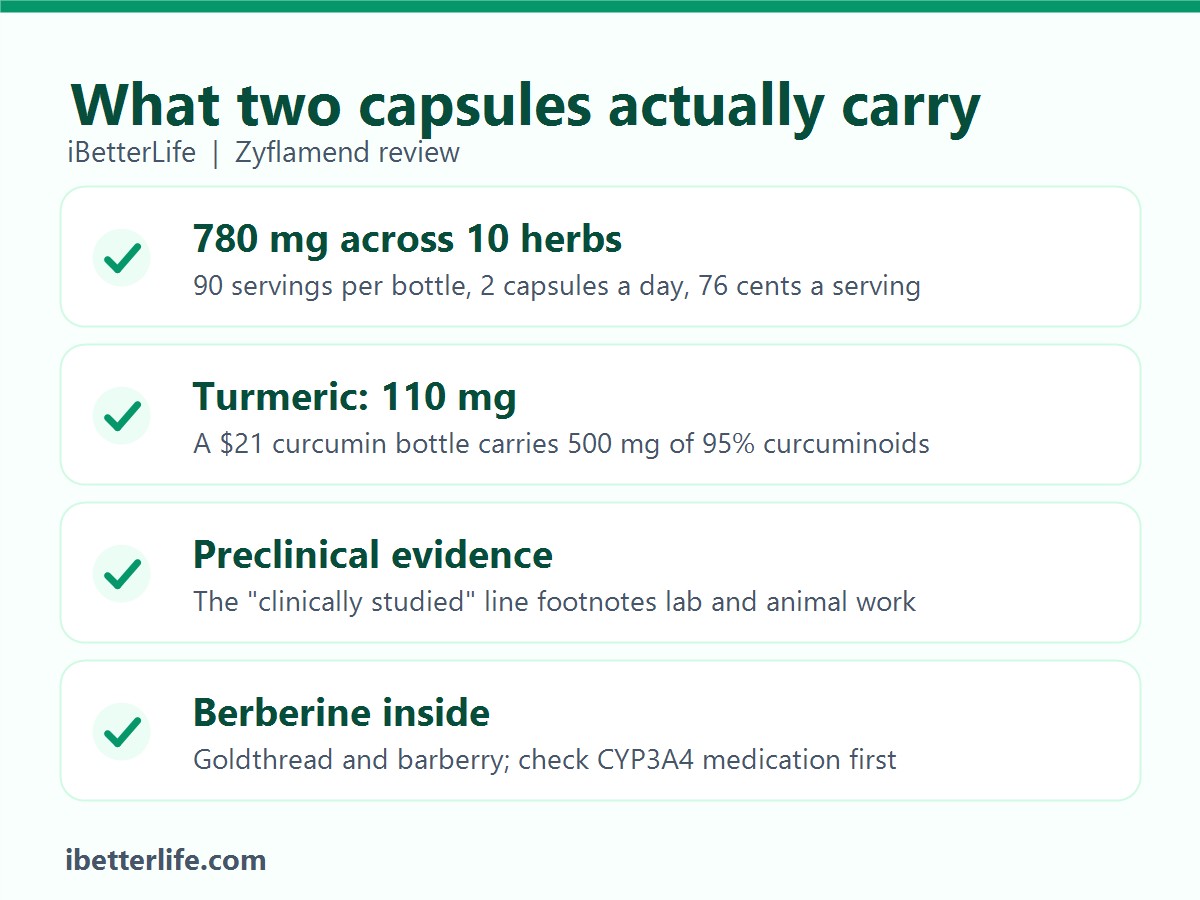
Two vegetarian capsules per serving, 90 servings per bottle, 780 mg of herbs in total. The panel lists rosemary 150 mg (100 mg supercritical plus 50 mg hydroethanolic extract), turmeric 110 mg, ginger 100 mg, holy basil 100 mg, organic green tea 100 mg, hu zhang 80 mg, Chinese goldthread 40 mg, barberry 40 mg, organic oregano 40 mg, and Chinese skullcap 20 mg.
The label also carries certifications that cost money to keep: Non-GMO Project Verified, NSF Certified Gluten Free, 100% vegetarian, no synthetic fillers, and no DLPA — the phenylalanine derivative New Chapter removed from this formula years ago. The capsules come in a dark glass bottle, which is one reason the price feels premium before you open it. One bottle is 90 days, so the habit costs about $22.70 a month.
What I like
- Ten extracts, several of them supercritical. Rosemary, ginger and oregano use CO2 extraction rather than plain dried powder, a more expensive process that keeps volatile oils intact.
- The formula is not just turmeric with a markup. Goldthread and barberry supply berberine, hu zhang supplies resveratrol, and green tea adds EGCG — a broader anti-inflammatory story than a single curcumin capsule.
- The paperwork is real. Non-GMO Project verification and NSF gluten-free certification are third-party audits, not marketing words.
- Buyers report specific, checkable changes. The most useful reviews name a problem — jaw pain from bruxism, morning stiffness, post-workout swelling — and say whether it came back when they stopped.
- Both retailers charge the same price. $67.97 at Amazon and iHerb, so the button you click does not decide the cost.
What buyers say
“Zyflamend has helped my joint health and mobility. I also like all the natural ingredients.” — DeeDee, United States, Jul 2026
“I started taking these as an alternative to a Botox injection in my jaw for bruxism. After a month, I no longer woke up feeling as though someone had punched me in the jaw.” — iHerb verified buyer, United States, Jul 2026
“It does irritate the stomach, so if you have a sensitive stomach eat before and take it slowly. I needed to stop it after two weeks of using.” — iHerb verified buyer, Israel, Jan 2026
“After using Zyflamend for sixty days, I am experiencing a positive response in my joints.” — iHerb verified buyer, United States, Jul 2026
Where it falls short
- The price per herb is high. 76 cents a day buys 780 mg across ten ingredients, which works out to 2 to 15 cents per herb per day depending on how you divide it. A single curcumin extract delivers a clinical dose of one herb for less. The premium buys convenience, not milligrams: if the point is one bottle instead of four, that is what you are paying for.
- Turmeric is a token amount. 110 mg of turmeric extract is not a curcumin dose; a 95% curcuminoid capsule carries 500 mg of the active fraction alone. If curcumin is your goal, this is an expensive way to get it.
- The evidence is preclinical. Cell and animal studies do not tell you whether your knee hurts less in six weeks. The brand’s own footnote says as much.
- The oregano is not subtle. Reviewers describe a strong taste and an aftertaste that takes weeks to get used to, and stomach irritation is the single most repeated complaint on the iHerb page.
- Berberine deserves a conversation. Goldthread and barberry are berberine sources; berberine affects CYP3A4 and blood-sugar handling, so anyone on a statin, a blood thinner or diabetes medication should ask a pharmacist before adding this.
How it compares
Prices checked November 19, 2026. Zyflamend wins on breadth and label quality; it loses badly on curcumin per dollar.
| Spec | Zyflamend | NatureWise turmeric | Move Free Advanced |
|---|---|---|---|
| Price per serving | ~$0.76 | ~$0.36 | ~$0.50 |
| Actives per serving | 780 mg, 10 herbs | 2,250 mg blend + 500 mg curcuminoids | 1,500 mg glucosamine + 1,500 mg MSM |
| Turmeric dose | 110 mg | 2,250 mg | None |
| Servings | 90 | 60 | 40 |
| Best for | One-bottle herb blend | Curcumin per dollar | Cartilage building blocks |
If turmeric is the point, the turmeric picks in our joint guide cost a third as much per serving. If you want glucosamine and chondroitin rather than herbs, Move Free is the mainstream choice and also cheaper per day.
How to use it
Two capsules a day, with food, is the label dose; the reviews that report stomach trouble usually took them on an empty stomach. Give it four to six weeks before deciding — the buyers who stopped early tended to stop in week two. Do not double the dose to speed it up; ten extracts at once is already a lot for a sensitive gut. If you take prescription medication, run the berberine herbs past a pharmacist first.
Who should skip it
Pregnant or nursing women should skip it, and so should anyone with a history of gallstones or liver disease, because turmeric and berberine both affect bile and liver enzymes. If you are looking for the cheapest way to get curcumin, this is the wrong bottle. If you have never taken a strong herbal blend and your stomach is sensitive, start with one capsule for a week rather than two.
FAQ
Is Zyflamend clinically proven for joint pain? Not in the sense the phrase implies. The blend has laboratory and animal data on inflammatory pathways, and New Chapter footnotes its “clinically studied” line to preclinical testing. I could not find a published randomized trial of Zyflamend with joint-pain outcomes.
Can I take it with ibuprofen? Generally yes, but the combination raises the chance of stomach upset, and both can irritate the gut lining. If you take an NSAID daily, ask your doctor before stacking a berberine-containing blend on top.
How long before I know if it works? Four to six weeks at two capsules a day is the window buyers describe, and it matches how herbal anti-inflammatories are usually trialed. If nothing has changed by week eight, the money is better spent on a curcumin extract.
Bottom line
Zyflamend is a well-made bottle with an honest ingredient list and a dishonest-feeling price. $67.97 for 90 days of ten small herbal doses is a convenience purchase, not a value purchase — and if curcumin is what you are after, 36 cents a day buys five times as much of it. Buy this if you want the blend and your stomach agrees with it; otherwise buy the turmeric.
